Showing posts with label author interview. Show all posts

Tuesday, December 14, 2021

Meet Children's Author JD Wise on his Pump Up Your Book Tour


Here's  a bit about JD Wise: 
 
JD Wise is a West Virginian-born author who believes that the world can be changed for the better, by one person, one time, doing the right thing.
 
“Just think what would happen if we all did that,” said Wise.
 
Wise is happily married to the love of his life. Together, they have four wonderful children, who are the true inspiration for the book.
 
He is also camera-shy!
 
Why did you pick to write books for children/MG/YA?
 
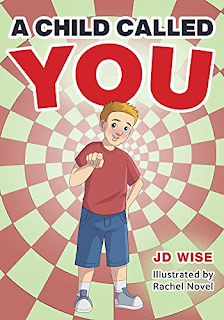
My first children's book A Child Called YOU started out as an art project that I was playing around with one day, and it just bloomed into a book.
 
"I like to see the face of smiling children who love to read! The satisfaction this brings is truly amazing. I spend my time thinking of new book ideas and how I can use my work to inspire the younger generation all around the world."

What types of books do you like to read, and what do you do when you are not writing?
 
I think that the only books that I have read in the last few years have been picture books (I have a four year old).  It's Not Easy Being a Bunny by Marilyn Sadler is our number one book. When I'm not writing, I spend a lot of time in the woods and outdoors. I work in my garden and keep the yard up.
 
Tell us about Nomophobia and how the story came to be. 
 
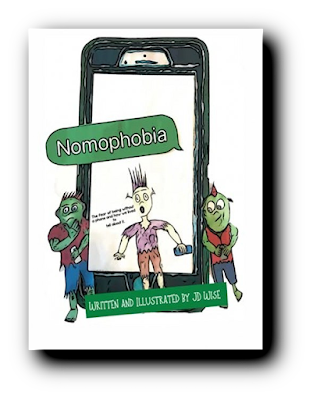
Nomophobia is a book about 3 modern-day children who are addicted to their cell phones.  The thought process started when I was at the doctor's office with one of my children. The waiting room was full that day. The nurse called one child but he would not go in until the game on the phone was over. Another time, a boy in the family told his grandma that he didn't need to learn how to tell time because if he wanted to know what time it was - then he'd just ask the phone.
 
Nomophibia is a somewhat true, mostly exaggerated story of modern-day children - children who have spent way too much time on their phones.
 
Here's a peek at Nomophobia:
 

Hello, Reader. My name is Joe. Welcome to NOMOPHOBIA. This is a somewhat true, mostly exaggerated story of myself and my siblings. We use to spend all day, every day on our phones. TEXT. CHAT. TWEET. PLAY A GAME. REPEAT. That's how we spent our day. At least that was until... our overused smart phones mysteriously turned us into ogres.


How do you go about researching for your stories?
 
This story was very easy to research. Children are always on their phones. You can go anywhere, at any time, and find a kid on a phone. The fit starts when you try to take away the phone to have them do something else. Doors slam, feet stomp, the ogre appears.
 
Have you written other books? if so, tell us a bit about them.
 
Yes. My first book is A Child Called YOU published by Mascot Books. This book is about You. The reader, you. This book displays kindness without judgment for everyone. It also talks about celebrating our differences and doing so is the true expression of kindness that we all need. A Child Called YOU is the recipient of a Mom's Choice Award, as well as a Reader's Favorite award.

What's next for your writing?  Are you working on a new story? 
 
I am presently working on a few other books. Wonderful, Mighty, Me is the second book in the Kindness is for Everyone series. I hope to release it in the summer of 2022. 
 
What advice do you have for other authors? 
 
Use the rejections you receive to your advantage. Once you've completed your manuscript, use the buddy system and let someone critique your work. Don't be easily offended.
 
Anything else you want your readers to know?
 
I wrote Nomophobia to inspire kids to look beyond what their phones have to offer. There is way more to life than a screen. Thanks for reading! Don't forget to pick up a copy of  Nomophobia.
 
Where to find the author and his book:
 

Visit JD Wise on Instagram and Facebook.

 
Find his books on:

Amazon


Wednesday, February 17, 2021

Meet Middle Grade Adventure Author Suzy Davies

The internet can be a intimating place which pulls you in and can quickly overwhelm you. On the other hand, it can be a place to connect with people with common interests and occupations. I've met several authors through the internet and social networking sites. It's always gratifying to see how professional and friendly they are. I met today's guest on Twitter when I found out she wrote for MG readers and was also a teacher. As I've said before, I love interviewing teacher/authors because of their commitment to opening avenues of reading to young people and those not so young-at-heart. Please join me in welcoming Suzy Davies and her wonderful books to Carpinello's Writing Pages.
 
First, here's a bit about Suzy:
 
Children’s Author and Poet, Suzy Davies was born in Reading, Berkshire, in England. She is a former Lead Teacher of English, and a certified Life Coach with Counseling skills. She believes in the magic of the imagination, and the power we have to create ourselves and realise our dreams.

A graduate of The University of Leicester, (Applied Sociology with Social Psychology,) and a postgraduate of The University of Sussex, (M.A English Literature,) Suzy began her writing career in 2012. She wrote her first children's book in 2016, which was published traditionally. Now, she is a full time writer.

Suzy lives in Florida, with her husband, Craig, and two semi-wild cats, Cubbie and Dinky.
 
Why did you pick to write books for children and MG readers?


I write Picture Books and Middle Grade. My most recent book, The Girl in The Red Cape: A Mystical Sled Ride, is a high Middle Grade which will also appeal to young adult readers and adults who are young at heart.

I enjoy writing children’s books because I think books make a huge difference in children’s lives and have a significant impact on their development, personal life scripts, and life choices. I use my background as a former Lead Teacher and Life Coach with Counseling Skills when I write my stories. I like the messages in my stories to instill good values and positivity, for example, to teach children about the importance of family values, friendship, loyalty, teamwork, and kindness. I hope that my story, The Girl in The Red Cape, will also encourage children to have self-esteem and reach for the stars.

What types of books do you like to read, and what do you do when you are not writing?

I’m an avid reader. I like to read well-known award-winning books for children and children’s classic literature, including fairy tales and poetry. I read popular Indie kids’ books and unknown authors. I like to do research for books I am writing, and I always read around the themes and ideas for my books in the planning stage. I’m always drawn to non-fiction psychology books to revise my knowledge of archetypes which appear in my stories. I regularly read life coaching and self-help books. I also like biographies.

When I’m not behind a book, reading or writing, I like listening to music, watching films and looking after my cats. When the pandemic has calmed down, I hope to get out and about again walking on nature trails. I also have plans to do some traveling in America, and beyond.
 
How did The Girl in The Red Cape: A Mystical Sled Ride come to be?
 
The Girl in The Red Cape: A Mystical Sled Ride had its genesis in Charles Perrault’s Little Red Riding Hood of which it is a retelling. I have fond memories of the tale, and decided to revisit it. I thought it would be nice to set the tale in a snowy landscape, and the idea of The Junior Iditarod in Alaska came to me.

I saw images of scarlet flashing through the woods, and imagined dog teams pelting across oceans of snow in the tundra. I saw spectral snow, lit up in the moonlight, like dust from the cosmos, the shadow of a great mountain, with a snowy peak - a metaphor for the challenges faced by the rival dog-sledders.These moving images - fleeting at first - grew on me, and I found myself daydreaming. I pictured the dogs and their individual personalities, their strengths and weaknesses. I envisioned one in particular, a wolf dog, who would be central to the story.

One of my favorite films, “Dances with Wolves,” helped me visualise the dogs and the lone wolf. It was important to me to depict not only the central human sibling relationship between Stella and Billy, but also relationships between animals and humans, Man and Nature in my book. 
 
How did you research The Girl in The Red Cape: A Mystical Sled Ride?
 
I start with an idea. I obsess about it to see if it’s going anywhere. I “play” with settings and characters in my head. If I get really excited about an idea, I move on to the research stage.

At this stage, I delve deeper and deeper, focusing my research. For example, to research The Girl in The Red Cape I went “back to school” and successfully completed two online University courses; one about “fairy tales” including those of Charles Perrault, and The Brothers Grimm, and one specializing in Hans Christian Andersen's work.

When I do research, I spend a great deal of time in this planning stage, then the writing goes smoothly. Writing is architecture. You have to build a solid foundation for your castles in the air. And that means it is hard work, especially in the planning stage. The more immersed in your subject matter you become, the better your book will be.
I drew on my childhood in Wales to “see” the different kinds of snow featured in my story, and on my horse-riding treks as a child to envision the up and down motion of the sled teams. My walks in ice and snow in Cornwall a few years back helped me put myself in wild terrain. I worked as cabin crew in my younger days, and my trips in light aircraft were useful in depicting the aerial views of Alaska and the race in my book.

After all my imaginings, I realised I had to do some serious research about mushing in Alaska. I contacted Anna Stephan, Winner of The Junior Iditarod, 2019, and asked for her help.

Anna kindly explained many things to me. After speaking to Anna, I read some factual biographies about mushing, and got a topographical map of Alaska to familiarize myself with the geographical features encountered on the race. Anna made herself available to answer questions. I got to know her more and more, and a friendship developed.

I wanted my lead fictional character, Stella, to have something of Anna in her. Anna told me she loved to play the violin. So I created a passionate, musher/violinist as the female protagonist. I’m pleased with how she has turned out, and I hope Anna agrees that she represents all that is good about feisty heroines, feminism, and girl-power.

I must admit, Billy, the lead male protagonist in “The Girl in The Red Cape,” a hero in his own right, was inspired by the wizardry of Harry Potter and my love of J.K.Rowling’s work.

Tom is Stella and Billy’s Inuk step-brother, and I drew on my knowledge of Inuit people to draw his mystical, mysterious character.

Tell us about The Girl in The Red Cape: A Mystical Sled Ride.
 

The Girl in The Red Cape
is a  heartwarming, modern Coming-of-Age fairy tale, with plenty of action and adventure. And I felt the whole atmosphere of the Alaskan wilderness as a character. One of the central themes of my story is about how we create and “find” ourselves on the journey which is Life itself. J.R.R Tolkein inspired me when he said that not all those who wander are lost.

I explore this theme of wandering and loss by borrowing from Alaskan stories of The Alaskan Triangle, and weaving this phenomenon into my tale. Animal helpers Black-Claw, The Raven and Tag, The Fox show that their instincts are good, and they help retrieve lost objects and guide the human travelers through portals, obstacles and dangers on the journey that leads them home.

The silent strength of Tom represents the ability to wander with purpose, and he has the depth to become even more himself on his travels. There is something very sure and certain about him and he develops a quiet tranquility. The motto of my old university in Sussex, England provided some inspiration here: “Be Still and Know.”

Young people benefit from understanding that sometimes, we have to stand alone, and have the courage of our convictions.
 
Here's a peek at The Girl in The Red Cape: A Mystical Sled Ride:
 
Brother and sister, Billy and Stella, compete in the Junior Race with their dog-sledding teams. All kinds of dangers await them, not least the wolves. Their step-brother, Tom, a solitary Inuit, has angered the pack. Queen Wolf is missing. The wolves will make good their loss or else seek their revenge.
 
In this heartwarming, fast-paced fairytale retelling of Charles Perrault's, Little Red Riding Hood, Stella, a rookie musher is on the threshold of womanhood. The Girl in The Red Cape is running with wolves, dancing across the virgin snow. All alone, it's Stella against the wilderness. But sometimes, an invisible power supports her. And she has her comrades.
 
In this high-stakes action adventure story, anything could happen.
 
Who will catch a dream?

Have you written other books? If so, tell us a bit about them.

Yes, indeed, I have. I have written six others. My first book was a memoir. My other five children’s books all have elements of animal or nature writing, and in each book I have written something of the magic of a legend or fairy tale. Two of my books, Sleepy Animals, a picture book, and Celebrate The Seasons,  a Middle Grade book illustrated by notable Laurie Shanholtzer, are poetry books for kids.
 
Snugs The Snow Bear is a Middle Grade story illustrated by notable Peter Hall, and Luna The Moon Pig is a magical picture book story, illustrated by award-winning, world-acclaimed Sheila Graber.
 
The Cave is a middle grade story. One of the characters in this children’s action adventure story paved the way for Ariana, the tailor/seamstress in The Girl in The Red Cape.

What’s next for your writing? Are you working on a new story?

Ha! Ha! This question makes me chuckle. I’m always conjuring ideas and I always have books in progress. I have three completed books no-one has seen yet, and have about 4 or 5 new stories in the pipeline as works in progress. I like to keep busy. There will be another fairy tale retelling, that I can say.
 
What advice do you have for other authors?

Read and write every day. Believe in yourself. Learn from others and be humble.
 
Anything else you want readers to know?

I love the illustrations in the book, created by notable artist, Michele Bourke. My favorite one is the one of Stella who is standing in the snow in a red dress, playing the violin, with animals watching her. This, of course, is pure fantasy, but at the same time it is a metaphor for harmony with animals and The Natural World, and Stella grows to become a “Force of Nature” at one with the wilderness in the book. 
 
Real Musher Champion, Anna Stephan is a role model for young women, and I hope this shows. In my book, Stella wants to make something of herself. She fights against shyness and self-doubts, to be transformed into a believable heroine who is human, likeable, brave and strong. When you delve deeply into well-known fantasy fairy tales, they have something of reality in them. This is the paradox.
 
Children’s books are almost always deceptively simple. People tend to believe they are an “easy write,” when in fact they will only flow and sparkle if you have done the work. Children are an honest and discerning audience. I like this. It motivates me to give my best.
 
I’d like to thank you, Cheryl, for kindly inviting me here. I appreciate it. And thank you to all my readers worldwide for reading my books. I am truly grateful and blessed.
 
Where can readers find you and your books?
 
Suzy:


The Girl in The Red Cape:A Mystical Sled Ride:

Amazon UK 
Amazon US
 
Listen to an excerpt from The Girl in The Red Cape here.
 

Monday, June 8, 2020

Meet YA Author Annie Douglass Lima

Carpinello's Writing Pages is excited to be hosting Annie Douglass Lima again. Annie shares my favorite career: Teaching. A frequent guest here, she is presenting the final book in her Annals of Alasia fantasy series (released June 5th 2020). You'll learn more about this book as well as the others below. Also be sure to click on the link to her Amazon page as Annie is offering the rest of this thrilling series for 99 cents or Free through June 11th. And now,

Here's a bit about Annie:

Annie Douglass Lima considers herself fortunate to have traveled in twenty different countries and lived in four of them. A fifth-grade teacher in her “other” life, she loves reading to her students and sparking their imaginations. Her books include science fiction, fantasy, YA action and adventure novels, a puppet script, anthologies of her students’ poetry, Bible verse coloring and activity books, and a fantasy-themed cookbook. When she isn’t teaching or writing, Annie can often be found sipping spiced chai or pomegranate green tea in exotic locations, some of which exist in this world.

Why did you pick to write books for YA?

It’s not so much that I decided that.  The stories come to me, and when I write them, that ends up being the audience they fit best.

What do you do when you are not writing, and what types of books do you like to read?

I’m a fifth-grade teacher for my day job, so writing is what I normally do when I’m not teaching. When I have time to read, I enjoy fantasy or science fiction.

Tell us about In the Double Agent’s Service and how the story came to be.

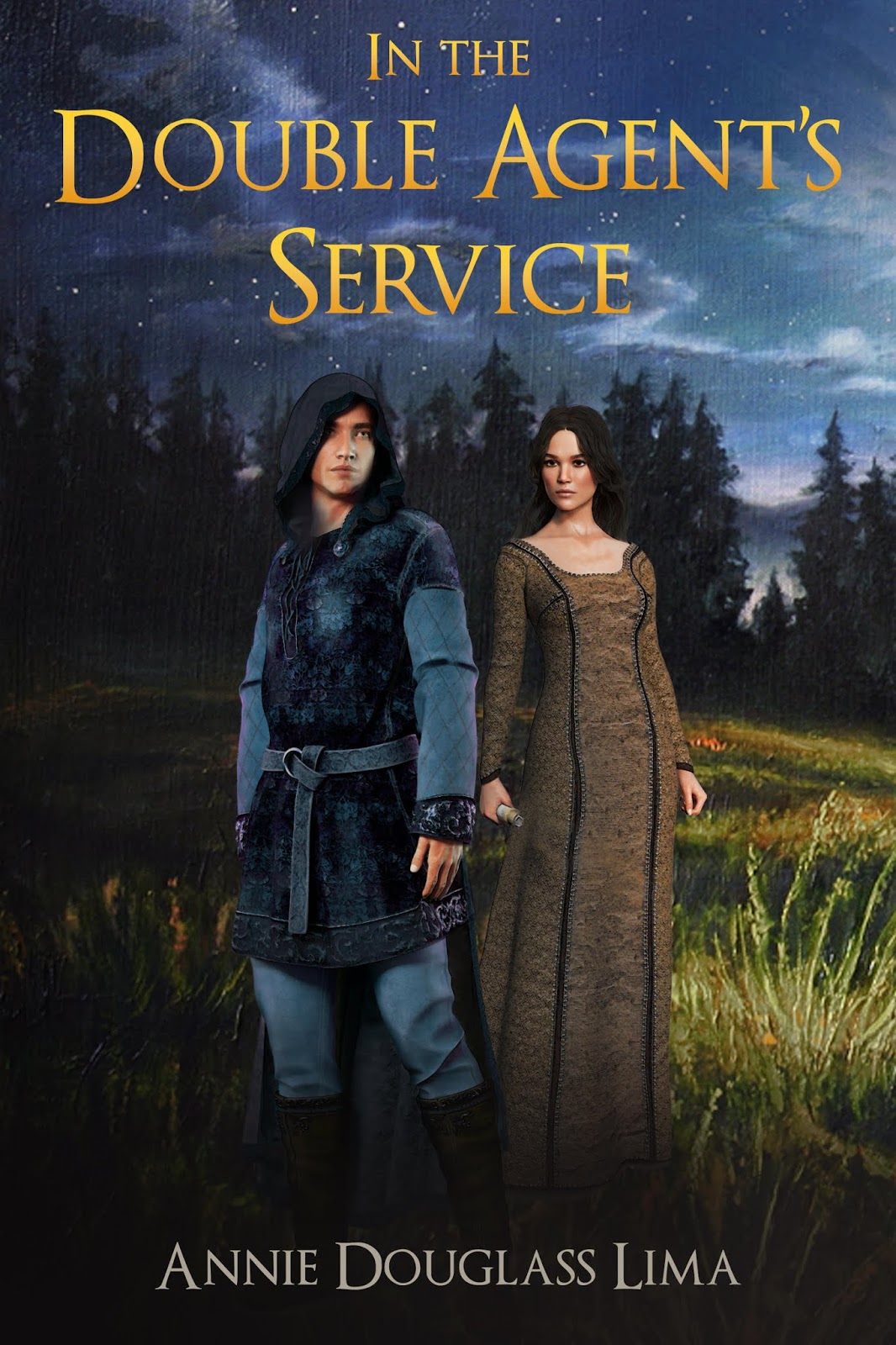
It’s the sixth and final book in my Annals of Alasia fantasy series. Erik would give his life to protect King Jaymin. However, when an old enemy shows up with new schemes, that may not be enough.
Anya longs to be noticed by the king’s handsome bodyguard. But as she finally gains Erik’s attention, the notorious spy and double agent Dannel blackmails her into fulfilling a favor she has owed him for years. Anya is forced into a terrible choice: save Erik’s life, or protect her homeland.
Can Erik and Anya thwart an assassin and prevent a war before Dannel destroys everything that matters to them and to the kingdom?

Here's peek at In the Double Agent's Service:

Pain.
Cold.
The smell of dry dirt.
A hard, gritty surface beneath his cheek.
Erik mentally catalogued the sensations in order of their intensity. He opened his eyes, blinked, and added another to the list.
Darkness.
Where am I? He struggled to sit up, and his pulse spiked at the realization that he couldn’t use his hands or feet. His ankles were bound together, and his wrists were tied behind his back.
What’s going on? Erik forced himself to a sitting position, noting the dirt floor beneath him, a rough wall at his back. Brushing his fingers over what he could reach of it, he discovered that the wall seemed to be made of the same hard-packed earth as the floor.
Am I underground? Though not completely smooth, the surfaces were too flat to be natural. Not a cave, then, but perhaps a cellar of some sort.
Or a cell.
He held his breath, straining his ears for any sound in the darkness. “Hello?” he whispered.
There was no response.
“Hello?” he said, a little louder. The acoustics hinted that he was in a small room. His head, already sore, throbbed anew at the sound of his own voice.
Erik leaned against the wall behind him, trying to keep calm. What happened? And where’s Jaymin?
Jaymin. Erik’s pulse started racing again. Had something happened to Jaymin?


How do you go about researching for your stories?

Not all of my stories have required research. For others in this series, I’ve needed to look up details like how to start a fire without a lighter or matches, edible foods that can be found in the mountains, what’s involved in a medieval banquet, lacemaking techniques, and what colors different animals’ eyes glow in reflected light at night. The internet is great for finding out random facts!

Have you written other books? If so, tell us a bit about them.

Annals of Alasia (a young adult action and adventure/fantasy series): When one kingdom invades another, five young people are caught in the middle. As they work to uncover the truth, spy on the enemy, recruit an army, hide their identity, and protect the innocent, can they change the course of both kingdoms' destinies? (The first four books can be read in any order, and each one can stand on its own.) Prince of Alasia: An orphaned prince and his young bodyguard must disguise themselves and go into hiding after the kingdom of Alasia is overrun by invaders.  Can Prince Jaymin save his kingdom - and himself? In the Enemy’s Service: A young girl enslaved by invaders discovers ways to spy on the enemy and help her captive people – until her own father is implicated in the betrayal that led to the Invasion. Prince of Malorn: When Regent Rampus tries to take over Malorn, Prince Korram must flee for his life. Can he convince a rustic tribe to help him fight for his throne? The Nameless Soldier: The lone survivor of a brutal attack, can a teen warrior reclaim his honor and find a way to fight for his crippled kingdom under enemy occupation? King of Malorn: Pursued by assassins, can Princess Kalendria help her brother reclaim his throne and prevent a war - and catch the handsome neighboring king’s attention while she’s at it?


The Krillonian Chronicles: Set in a world alarmingly like our own but where slavery is legal, this action and adventure series follows the story of a young slave and the martial art he is passionate about. The Collar and the Cavvarach: Bensin, a teenage slave and martial artist, is desperate to see his little sister freed. But only victory in the Krillonian Empire's most prestigious tournament will allow him to secretly arrange for Ellie's escape. Dangerous people are closing in on her, however, and Bensin is running out of time. With his one hope fading quickly away, how can Bensin save Ellie from a life of slavery and abuse? The Gladiator and the Guard: Sentenced for a crime he didn’t commit, teenage slave and martial artist Bensin must learn to survive in the world of the arena, where any false move could result in death. Can he stand against the cruelty of the arena system and seize his freedom before that system crushes him? The Student and the Slave: Bensin and his sister Ellie are desperate to rescue Coach Steene, who sacrificed himself for their freedom. When members of rival street gangs express interest in Bensin’s combat skills, he realizes he may have a chance to save Coach…at a cost.

Heartsong (a young adult science fiction novel): Thirteen-year-old Liz Smith has been ripped away from one foster family after another for years, so the idea of a permanent home is tantalizing. Who cares if that home is a colony sixty-five thousand light-years from Earth? But when the adventure of a lifetime turns into the disaster of the cosmos, Liz can only retreat so far into the books that have always sheltered her from loneliness and loss. Trapped in half-truths and secrets that leave her questioning reality, can one orphaned bookworm find a way to stop two races from destroying each other … and somehow write a happy ending to her own story?


What’s next for your writing? Are you working on a new story?


Not at the moment. I hope to draft another novel this fall, but I’m not sure yet what it will be about.


What advice do you have for other authors?


Don’t try to write a scene perfectly the first time or get frustrated if it doesn’t turn out as well as you hoped. Just get your ideas on paper in whatever rough form you need to, and never mind selecting the perfect words or fixing any mistakes. Leave the scene alone for a few days, and when you come back to it, read through it and smooth out the obvious errors. Repeat several times. If possible, read it aloud to someone; that will help you hear errors or issues you may not notice otherwise. I’ve found that it usually takes lots of passes before I’m satisfied with something I’ve written. Trying to make it perfect the first time is ridiculously time-consuming, stressful, and next to impossible, at least for me.


Anything else you want readers to know?


A young teenage writer I’ve been mentoring, Sabrina Gulliver, is in the process of publishing her first book (a young adult science fiction adventure called Runaway from Khoeli). The Kindle version is now available on Amazon for preorder! I would love it if you’d take a look, and if it seems like something you might enjoy, please do encourage her by ordering a copy. Or maybe a young person you know would like to read a novel written by a high schooler and perhaps be inspired in their own writing. Please consider “gifting” one to someone else who might like it! You can find Sabrina on Instagram at sabrinajoygulliver.

Where can readers find you and your books?


On Amazon! You can see them all on my Author Page.


Wednesday, January 20, 2016

Meet MG Fantasy Author Marie C. Collins

Carpinello's Writing Pages welcome MG/YA author Marie Collins.

First, a bit about Marie:

I wrote my first work of fiction in 6th grade. It was a monologue, spoken by a tomato as it sat on the conveyer belt of a ketchup factory. Hint: It didn’t turn out well for the tomato!

In other words, I was not writing precociously at a young age. For me writing has simply always been the thing I enjoy most about doing anything. For instance, in high school, I made up for a slacker-performance on an ecology lab by writing a comic tutorial on how not to do science.

Yet, up until the beginning of my junior year in college, I was a bio major. I thought it was somehow a “cheat” to make a career out of doing what came easily to me. I don’t remember what turned me around, but I changed majors. I squeezed the requirements for two new ones—journalism and English lit—into the last two years of school, which meant taking five writing courses a semester. I cried a lot—no really, I sobbed. I had a mountain to climb every term. It was writing boot camp. But it taught me I could write (and edit) for 40 hours a week and be a happy clam, which I then did for 30 years.

Why did you pick to write MG/YA books?

That’s a really good question. I suspect a few things pointed me in that direction. I felt very misunderstood as a child. Around age 8, I made a fists-clenched-at-sides vow never to forget how it feels to be a kid. Perhaps that stuck? I have always enjoyed coming-of-age fiction and children’s literature. But also, I see this as a very hopeful and optimistic age—an age that is freer to think about the world in grand, wishful terms, as if it were just waiting for us to mold it. It’s a time when, for a moment, all things are possible—even as mysterious forces conspire to narrow those options into more finite realities. The idealistic side of me is still this age and is constantly nagging more-realistic-me to doing her bidding.

What types of books do you like to read?

I enjoy just about everything except historical nonfiction. Which is not to say I don’t appreciate history! I live in a 125-year-old house; I am a lover of all things vintage; I am fascinated by the stories that pour from genealogy; and I LOVE biography. I guess I just need my history with a spoonful of story! (Like what Cheryl does with her historical fiction books.)

Otherwise, I cut my reading teeth on the Brontes and am still a big fan of gothic fiction. I am also a crime junkie. While that’s not unusual, I think the obsession is personal for me, as my family has an unsolved mystery. My grandfather disappeared when my father was only 9 months old. No trace of him was ever found, even when the Veterans Administration conducted an official investigation to determine whether he should be declared dead for life insurance purposes. One and two generations later, his story is still a quiet centerpiece in our family.

When you are not writing, what do you like to do?

I am quite a homebody. I live someplace very beautiful and simply enjoy being here. As readers of A Brief Stay at Earth Human Camp may guess, I also enjoy exploring different cuisines. I am a 40-year proponent of buying organic and local; I shape-shift into a farm wife every August, then preserve everything in sight. I love hiking, talking, and other ways of spending time with family and friends, especially my daughter. I love my dogs, science, wilderness, and wildlife—and vacations that take me to wild places. And I read every night, even if I’m so tired I only last a handful of pages.

Tell us about A Brief Stay at Earth Human Camp and how the story came to be.

I raised my daughter as a single mother, and one of the things I put off during those years was writing fiction. There simply weren’t enough hours in the day. But I put it at the top of a to-do list for when she went off to college. A Brief Stay at Earth Human Camp came out of my determination to transition to a new level of writing at this stage of my life.

I started by developing the main characters and how they lived; then I developed a world that would challenge them at every step. A driving idea, as I say in the dedication to the book, was my daughter’s fear when she was young that a robot might somehow take my place without her knowing it.

A Brief Stay at Earth Human Camp introduces my main characters, Anne and Atticus, to Earth human society (and to their own alien “talents”) by way of sleepaway camp. The world I created slowly encroaches on them there, but is more of a force in the next book of the series.

Here's a peek at A Brief Stay at Earth Human Camp:

Once you find out your mother is an alien, what ISN’T possible?


That’s what 12-year-old Anne and 10-year-old Atticus Reade want to know. Minutes after learning that their mother is from the planet Farbookonia and that their parents’ secret project has put them all in danger, the children are wrenched from their sheltered existence in the Midwest and whisked off to a safe sleep-away camp in New Jersey—each with a tiny, protective “Globot” on one shoulder.

Painfully aware they’re not like the others at camp, Anne and Atticus do their best to fit in while concealing their alien background and the “special talents” that go with it. But everything is so new to them, they have a hard time sorting reality from fiction. Quirky campers, campfire ghost stories, a bizarre camp director, Anne’s mysterious dreams, and Atticus’s unusual animal encounters are all equally disturbing.

Just as they start getting the hang of life among young Earth humans, a broadcast on the Rec Hall TV shakes things up, and things that are truly strange emerge from normal newness. It turns out Anne and Atticus—and their new friends—may not be safe at camp after all. A Brief Stay at Earth Human Camp thrusts them into a reality they wish was fiction.

Have you written other books? If so, tell us a bit about them.

I have written nonfiction books and other materials for others for 30 years, but A Brief Stay at Earth Human Camp is my only completed work of fiction to date. I refer to the work I did for hire because it helped me develop some of the tools I used to write my first novel.

What’s next for your writing? Are you working on a new story?

While planning A Brief Stay at Earth Human Camp, I wrote the backstory and trajectory for the entire Secrets of Farbookonia series, and I am determined to finish book two by the end of this year. It’s called The Quest for Normal, and it takes my formerly sheltered characters Anne and Atticus, as well as the beleaguered boy Max they met at camp, to a small town in Maine, where we begin to see what’s going on in the world around them.

What advice do you have for other authors?

I guess I would try to demystify novel-writing as 10% inspiration and 90% perspiration. There are many good ideas for books, but authors are people who develop ideas into books. Sure, I’ve heard the stories of authors sitting down, starting to type, and hammering out their novels from beginning to end (with a slap-dash pull of the last page from what in my mind is the cartridge of a typewriter). But that’s uncommon, in my opinion. I use many practical tools to maintain control over my writing—outlining, charting, diagramming, deep questioning—and I revise, revise, and revise, then revise some more.

Anything else you want readers to know?

I recently added an online store to my website where readers can buy signed books and my handmade classic-book-charm necklaces. Also, I really enjoy reader contact!

Where can readers find you and your books?

Marie

Website
Facebook
Goodreads
Twitter

A Brief Stay at Earth Human Camp

Amazon
Smashwords
My Website

Tuesday, January 19, 2016

Meet MG/YA Fantasy Author Kandi Wyatt

Carpinello's Writing Pages welcomes fellow teacher and fantasy MG/YA author Kandi Wyatt.

First, a bit about Kandi:

Kandi is a wife, mom of five, teacher, artist and author. In her free time, she enjoys writing fantasy, writing Christmas programs, drawing using graphite and colored pencils. Portraits are her specialty. She also enjoys photography. Thank you to her photographer husband who has let her join his journey in photography as well. She is both his model and apprentice. On occasion she’s his assistant when working with clients and when he needs a 'light stand with feet'.

Why did you pick to write books for Middle Grade and Young Adults?


I have always loved the books my kids have enjoyed. When I began writing, I wrote for them. They were in the middle grade to young adult genre. I wanted to give them good, clean books so they fall more into the middle grade genre. My most recent work in progress will be middle grade because I am writing for junior high students.


What types of books do you like to read?

I love Sci-Fi, Fantasy, and uplifting Christian fiction. I have found Clive Cussler’s Oregon and Fargo series to be quite fun and intriguing as well.

When you are not writing, what do you like to do?

I enjoy spending time with my family, photography, and drawing.

Tell us about Dragon's Future and how the story came to be.

Dragon’s Future is about a set of twins who become dragon riders. They learn of a dragon rider from another colony which is after a mysterious plant with the power to renew or destroy the dragon population. The twins and their friends must fight for their dragons’ future.

The story came about on a Christmas vacation. The family was traveling to Eastern Oregon to be with my husband’s family. Along the way, there was a discussion about how we named our daughter incorrectly. Her name is Dawnya, but she hates mornings. I jokingly asked if she should be called Duskya. Later that same evening, we traveled past Three Mile Canyon, Oregon. I saw the sign, and in my mind’s eye, I saw a dragon breathing fire down a box canyon. The two events merged to create the story.

Here's a peek at Dragon's Future:


Every child of Woolpren dreams of becoming one, but only a few are chosen. Now, ten-year-old twin brother and sister, Ruskya and Duskya, have been chosen to join an elite group of riders: dragon riders. Full of awe and excitement, the twins leave their mother, and their home, to train for their new lives.

Fifteen years later, dragons are becoming extinct, and riders are rare. One day, Ruskya is at the general store in town when a man announces that he is recruiting new dragon riders. Ruskya goes undercover and discovers that there is another colony of riders with their own agenda—a quest to find a mysterious plant that could restore the dragon population, or destroy it. When a battle erupts between the two colonies, it’s up to Ruskya and his friends to fight for their dragons’ future and their lives.

Have you written other books? If so, tell us a bit about them.

There are five books in the Dragon Courage series. Dragon’s Future is Book 1. Dragon’s Heir follows Braidyn, a character that we meet in Dragon’s Future, as he is older and coming of age. He must temper his need for justice with mercy, or he will lose everything he holds dear. Dragon’s Revenge, Book 3, follows Kyn, the youngling from Book 1, as he tries to fill the hole that his twin left. He travels to a new land finding wild dragons. He and his new friend must figure out how to bring peace to the land. Dragon’s Cure, Book 4, deals with Duskya’s daughter, Carryn. Carryn must learn to forgive or to be held as a prisoner in her own heart. Finally, Book 5, Dragon’s Posterity, follows Ruskya’s son, Ardyn and Kyn, as they create the youngling challenge. Together they help younglings transition to full-fledge riders.

My other book is The One Who Sees Me. It is a historical Christian fiction. I took a story from the Bible and rewrote it in a different time, place, and changed the names. In essence, it is taking a new look at an old story. The reader follows Faru through life as she is sold from one master to another. Every time she thinks life is great, she gets a curve-ball thrown at her. She must adapt and learn to trust The One Who Sees Me.

What’s next for your writing? Are you working on a new story?

I am working on a middle grade fantasy about four eighth graders. There are three boys and one girl. They find what they think is a thunderegg on the beach. Their science teacher helps them out and tells them it isn’t a stone at all. They are surprised and vow to keep what they have found safe. It is the first in probably a trilogy that deal with junior high kids and fantasy creatures. They are set in a fictionalized version of my home area and the school where I teach. Last year when I taught a junior high study hall, I found students who hated to read. I wondered why not get them to read by writing them into a story. This is what has come from that idea. I hope to work on it during National Novel Writing Month in November.

What advice do you have for other authors?

Keep writing. Keep networking. Make yourself a real person. Enable people to get to know you. One thing I have learned about being an author is it is so much more than just writing. You must interact on social media. This is more than saying, “buy my book.” It is a matter of letting people know what your interests are and sharing about them. I don’t sell a book by saying, “buy my book”. I sell books when I introduce myself, talk about my kids, and why I write. Eventually, someone says, “what is your book about?” That is when I sell a book.

Anything else you want readers to know?

I never dreamed of being a published author. I still sometimes have trouble saying I am an author. However, it has been a joy to get to know people I would never have had the opportunity to meet. I would love to some day actually have face-to-face contact with these new friends.

Where can readers find you and your books?

 
Kandi


My books are available on Amazon, Barnes & Noble, and iTunes. Here are the Amazon links:


Tuesday, October 14, 2014

Meet Children's Author Stephanie Dikey


 Carpinello's Writing Pages welcomes Stephanie Dikey, author and teacher, along with her book The Adventures of Phoenix and Tucson: The Great Rescue.

First, a bit about Stephanie:

Stephanie Dikey is a third grade teacher in Webster, New York. Writing was sometimes difficult for Stephanie, but when she began her career as a teacher, she developed a passion for writing and teaching the craft to her students. Her students have always been interested in her furry children, Phoenix & Tucson, and Stephanie often enjoys sharing real-life stories about their friendship. Now she finally has a book to share about their special bond! Says Stephanie (a.k.a. Mrs. Dikey), “I want my students to believe that they are writers even if it isn’t easy. Everyone has a story and it’s worth sharing.” Stephanie found her passion for teaching at a young age and began teaching in 2002. She received her Master’s in Literacy in 2005. “The more you read, the better life you will lead,” is something Stephanie lives by when teaching her students. In her free time, she enjoys traveling, walking on the beach, exercising, and spending time with her family and friends.

Why did you pick to write books for children?

I am a third grade teacher, and I am always inspired by my students. They love to ask questions about my pets, and they love to hear stories about them. This inspired me to write stories for all children to read and enjoy. Also, I was a reluctant and struggling writer as a young child. It was not until I began teaching students the craft of writing that I began to enjoy writing myself and celebrate writing with kids!

What types of books do you like to read?

I like to read realistic fiction books and biographies. I also enjoy reading many kinds of children’s books (even as an adult)!

When you are not writing, what do you like to do?

I enjoy reading. I also like to cook and try out new recipes. Finally, I enjoy taking my dog for a walk.

Tell us about The Great Rescue and how the story came to be.

My pets are both rescued animals. It is a story about their rescue and the special bond they created immediately. I think it is important for kids and adults to see the special friendship that animals can form. We can learn a thing or two from our pets. :)

Here's a peek at The Great Rescue:


In The Great Rescue, the Hopelynns are excited to have Tucker join them in their home. As Tucker’s name changes to Phoenix, many other things change as well. He has left his friends behind at the shelter, and although he is happy with his new parents, he begins to feel lonely at the Hopelynn’s house.

Soon he will not be lonely. Phoenix will welcome his new furry sister, Tucson, into his home and show her that there is always room for more love . . . and adventure.


Have you written other books? If so, tell us a bit about them.

I am working on the first adventure that Phoenix and Tucson will go on. They will be introduced to another fun animal…and maybe it will turn into another unlikely friendship! :)

What advice do you have for other authors?

My advice is to always have fun writing. The minute that it feels like it is “work” is when an author has to review his/her purpose. Writing is all about expressing oneself and sharing thoughts with the world.

Anything else you want readers to know?

I also conduct presentations to children about becoming an author and the process of writing.

Where can readers find you and your books?

Readers can follow my blog and check out new adventures with Phoenix & Tucson at
www.dreamreacherbooks.com.  My book can be found on Amazon and Barnes & Noble. 

Tuesday, April 15, 2014

Meet Children's Author Randa Handler

Carpinello's Writing Pages welcomes international journalist and children's book author Randa Handler and her story The Boy Who Spoke to God.

First, a bit about Randa:

Randa Handler is an international journalist, publicist and publisher. Her interview with actor Rock Hudson (his last) was published worldwide. In 2003, Handler moved into publishing, successfully launching an educational series of children’s books used as ‘lesson plans’ by elementary school teachers. She is currently dedicated to writing and illustrating children’s books.

Why did you pick to write books for children?

I really believe that early education is key! Having worked at the UN and having been exposed to so many cultures, made certain needs clear. Most importantly: teaching in a fun way tolerance of all differences. I wanted to see if I could help somehow. Even if it's in a small way.


What types of books do you like to read?

I like to read all kinds of books. I basically get intrigued by the premise and the background of the author.

When you are not writing, what do you like to do?

I like to keep my mind busy doing something --it seems. If I'm not writing, you can find me starting some kind of project. I've rehabbed homes and furniture. Hobbies wise, I like to antique shop and catch a movie, an opera or concert.

Tell us about The Boy Who Spoke to God and how the story came to be.

I thought a long time about writing this book. Like many people in publishing, I shied away from
talking about anything that might be seen as spiritual in nature. At the same time, having worked with children's book authors and educators both in public relations and in publishing, I knew that children didn't have books that addressed their basic questions about God.  I decided to premise an early reader’s children’s book with exactly that.  I set out to try and find a way to do that without being religious, preachy, or slanted.  Believe me, that's a hard task. I thought if I set it as a fairytale, about a time long ago, it might be accepted. I decided on four tribes that find a way to live in peace and harmony despite vastly different religious beliefs. I will be happy if the book is accepted and is used as a tool to open a dialogue with a young mind.

Here's a peek at The Boy Who Spoke to God:

Unable to agree on their ideas about God and religious celebrations, four different ethnic tribes—Greeks, Chinese, Zulus, and Mayans—who live together harmoniously most of the year, combining aspects of each of their cultures to make their kingdom strong and prosperous, suddenly
become divisive when religious holidays approach. During such times, they cannot agree on the timing or manner of religious traditions, and they each have their own god who looks and dresses as they do.

When Niko, a young Greek boy, has several dreams of God, each tribe interprets the various details of his dreams according to its own view of God, further emphasizing the tribes’ differences in beliefs. Subsequently Niko is shunned for having created even more disharmony and for lying to the tribes, or so they think, as no one believes he dreamed of God.

To clear up all the confusion and arrive at the truth, Niko begs God to manifest in one final dream. This time God shows him that the tribes’ beliefs are actually different expressions of the same god. Niko concludes that God is like colorless and formless iridescent light, and the beliefs of all tribes about their gods are correct as these gods are like colors of the rainbow that derive from white light.


Have you written other books? If so, tell us a bit about them.
I have 5 books released and currently working on others. The Thanksgiving Dinner Platter takes place in 1941 when Thanksgiving became a national holiday and features the friendship between a Native American boy and a Japanese-American little girl. It even includes a real recipe for cornbread just like the one served at the first Thanksgiving dinner eaten by the pilgrims and Wampanoag Indians at Plymouth Plantation. The book concludes with the kids sharing the special cornbread with the Vets and thanking them for their service.

I also have two installments in the series Cubbie Blue and His Dog Dot. Book one sets the stage for this series of children’s books centering around the friendship and adventures of 3 multiracial kids and their special tiny friend Cubbie. Book two of the series What’s up with Mike? features a
blind child and helps kids learn how to deal with disabilities.

If I Were King centers around a feisty zebra who decides to befriend many jungle animals except other zebras. Winner of a 2013 Mom’s Choice Award, it focuses on finding true friendships and learning about boundaries.

What’s next for your writing? Are you working on a new story?

Right now I'm working on the third installment in the Cubbie Blue series.

What advice do you have for other authors?

Don't let rejections detract you from your goal. Practice makes perfect and try to always work with a good editor who will really give you the honest truth. Not a friend but a business associate.

Anything else you want readers to know?

I'm sure news about new releases will be posted by my publisher, Premier Digital Publishing or on my own website.

Where can readers find you and your books?


They can follow me on Twitter or visit my Facebook page.

My books should be available online and hopefully at all book retailers in 2014.